Leonardo's Method · Chapter 10 of 15
8. Influence
Vasari's claim about Leonardo's notebooks being read by others has an unexpected confirmation. There is physical evidence of actual readers in the notebooks themselves. The notebooks are written in mirror script. But in the Codex Trivulzianus, for instance, we find at least a half dozen instances where someone has written in ordinary script that this is a note[341] about architecture[342], water[343], painting[344] or a battle.[345] In Forster I, we find another note written in ordinary script: "This is a book entitled on transformation, that is from one body into another without diminution or augmentation of material."[346] Forster II contains a similar note in Latin: "Most powerful mechanics beginning at the end[347]" and five notes instructing one to invert the book[348] (i.e. read it in a mirror) followed by another: "N.B. This writing is inverted and is to be read in a mirror[349]," which phrase is repeated at the beginning of Forster III[350] and then repeated in abbreviated form another half dozen times.[351] Manuscript B has at least 49 notes in Spanish written right side round identifying the subject matter.[352]
But can we prove that Leonardo influenced others? There is some direct evidence. We know that Dürer had access to at least two folios of Leonardo's anatomical studies which he copied in reverse form into his Dresden Sketchbook[353]. Professor Putscher has drawn attention to parallels between Leonardo's anatomy and a series of drawings published by Titian, who may have provided a link with Vesalius.[354] Professor Pedretti has noted copies of mechanical drawings in Florence and Munich[355], and has brought attention to various sixteenth century manuscript copies of the Treatise of Painting[356]. Leonardo's instruments were studied by the clockmaker, Lorenzo della Golpaia,[357] who copied a number of them in his manuscripts.
Some of the evidence is indirect and more in the manner of smoking guns than the kind which would necessarily convince a jury. We know that from 1515 until the time of his death in 1519 Leonardo was in France where he served the king as mathematician, engineer, and in other capacities. It is therefore of some interest to note that there are close parallels between Leonardo's transformational geometry and the work of Claude de Boissi�re who was a mathematician to the king of France in the generation after Leonardo[358]; or similarly that a surveying instrument which Leonardo describes in the Codex Arundel, should have a close parallel in an instrument developed by Abel Foullon who was also an engineer to the king of France after Leonardo[359].
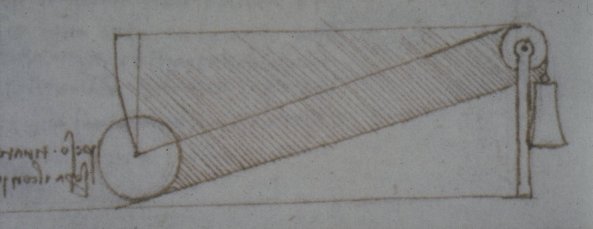
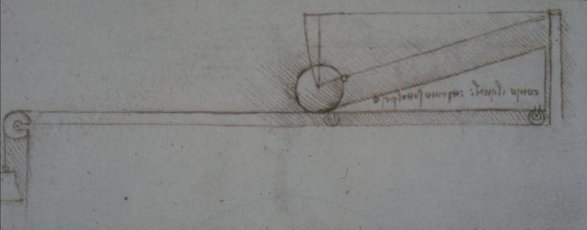
Leonardo had a particular interest in compasses and several types are known to have been copied directly by Lorenzo della Golpaia. Another type compass explored by Leonardo was developed into the Mordente compass.[360] As already noted above, in the Codex Atlanticus there is also a new kind of adjustable compass which Leonardo designates as a proportional compass (pl. 29a)[361]. Two generations later this compass of proportion found its way to Nürnberg, where it became part of a manuscript on perspective attributed to Lencker[362]; to Kassell, where B�rgi developed a particular version which became so linked with his name through publications by Hulsius (pl. 30)[363] and Bramer[364] that this instrument is still frequently assumed to have been his invention[365]. Probably via Mordente, word about this compass also reached Antwerp where Coignet[366] developed them in manuscripts that spread to Brussels, Paris, Madrid, Modena, Florence, Rome and Naples. The Coignet manuscripts are of further interest for two reasons. They acknowledge that some individuals at the time associated the instrument with Michelangelo although the original inventor of this instrument was already forgotten. Secondly these manuscripts contain an alternative form of this instrument which corresponds to that which Galileo claimed to have invented (1606)[367]. It is perhaps instructive to note that Galileo made analogous claims about having invented the telescope which is another instrument concerning which there is evidence in Leonardo's notes (pl 31-32)[368]. Galileo's fame is also firmly linked with his inclined plane experiments yet another theme that Leonardo explored a century earlier (pl. 33-34).
Some scholars might claim that such isolated examples of technology transfer have nothing to do with science in a deeper sense. In this context it is important to recall a fundamental shift in method that Leonardo helped to bring about: whereby geometry and science were linked through representation and construction, made possible through instruments and whereby one needed instruments to demonstrate geometrical principles. One consequence of these profound changes was that transformational geometry using instruments became part of the perspectivists' task. Danti's (1583) description of perspective in terms of transformational geometry reads like a direct paraphrase of Leonardo's own goals:
Since beyond the description of rectilinear figures it is very useful for the perspectivist to know how to tranform one figure into the other, I wish...to show the normal way, not only to transform a circle and any other rectilinear figure that is wished into another but also move to expand and diminish it in any proportion that is desired, in order that in this book the perspectivist will have all that is required for such a noble practice.[369]
The rise of universal measuring devices including various kinds of proportional compasses was a second consequence[370]. A third involved the way in which astronomy was studied. Leonardo's conviction that each planet is at the centre of its own elements, led him to the study the elements of earth, air, fire and water in relationship to centres of gravity. Astronomy and cosmology became for him problems of both geometrical and physical models. So he developed instruments to observe the heavens and he built orreries to explore the relationships of various planets. In the next generation this idea of model making was taken further by Peter Apian, author of the Astronomicum Caesareum (Ingolstadt, 1540), which used perspective to create three dimensional views of sections of the heavens and employed elaborate movable volvelles to picture relationships of planets and stars. He was, of course, visualizing the Ptolemaic world view and the details of his approach were occasionally "wrong." But the model making impulse remained alive and Jost B�rgi, a member of the Brahe circle at Kassell who studied the book, made his own physical models of the universe linked up with clock mechanisms[371]; while Kepler took Plato's abstract theories from the Timaeus and tried to construct physically a model of the universe involving the five regular solids, which he described in detail in his Mysterium Cosmographicum (1596). Ultimately it was the discrepancy between this instrumental model of the universe and the evidence of heavens which he observed by means of instruments, that led Kepler away from the Ptolemaic world view. In other words, the so-called paradigm shift of the Copernican revolution was not simply an abstract decision for which we have simply to imagine theoretical philosophical, psychological or sociological explanations. It was inspired by a new confrontation of evidence from instruments of observation, with that of instruments of model making: precisely that nexus that Leonardo brought into focus.
In this context Leonardo's work on compasses and telescopes can no longer be dismissed as amusing toys, or neat gadgets. His emphasis on instruments such as balances, automatons and clocks (cf. pl. 4, 25, 26) provoked much more than mechanical metaphors for the natural world. They provided the very framework that made it possible to think of the world in a scientific way. They established a visible standard which permitted one to insist on observation and experiment. And by means of instruments Leonardo set European culture on a quest for laws concerning four powers of nature: weights (pl. 27-28), which Tartaglia, Benedetti and Guidobaldo del Monte would take much further; motion (pl. 33-34), on which Galileo would build his reputation; percussion, which became the basis of Huygen's philosophy and force which in some senses had to wait for Newton. In short, Leonardo did have a method in his work and the questions he asked gave basic directions to the research programmes of the centuries that followed.