Leonardo's Method · Chapter 8 of 15
6. Method
In Leonardo's case this optimism sprang from his awareness that he had his own method for approaching science. Both experience and experiment (as in French the same word is used for both terms in modern Italian, although Leonardo sometimes distinguishes between them) are very much a part thereof. On CA125ra (c. 1490-1492) for instance, he notes "I find by experience that...[214]" On A47r (1492) he advises "Experiment as follows[215]," a phrase that returns on CA117va (1495) and D4v (1508). Sometimes he describes what is to be experimented as on CA338va (c. 1490): "Experiment on motion, the cause of the blow"[216] or CA151va (c. 1500) where he sets out: "To experiment the proportion of the intervals of descent."[217] Sometimes he describes precisely the means to be used, as in D3v: "To do an experiment how the visual power receives the [multiplication of] species of objects from its instrument, the eye, let there be made a sphere of glass five eights of a braccio in diameter."[218]
The interpretation of such passages has been a source of misunderstanding and controversy. In modern science there is a distinction between thought experiments carried out in one's mind and actual experiments using instruments and physical apparatus. Some scientists believed that Leonardo's ideas about science were purely theoretical, and thus assumed that he must have conducted only thought experiments. In 1972 this view was so strong that when the late Dr. Kenneth Keele and the author set out to examine whether Leonardo's claims about perspective had an experimental basis, the project met with considerable scepticism. This scepticism remained even when the evidence of the reconstructions established clearly that Leonardo must have carried out actual experiments. Since then the important work of Maccagno[219] has shown that a number of Leonardo's claims in the realm of hydraulics are also confirmed by actual experiment.
By 1490, the principles of classical geometry are a basic part of his experimental approach as we learn from CA109va: "Make simple propositions and then demonstrate them with figures and letters."[220] This he restates in more detail on A31r (1492): "I remind you that you should make your propositions and that you illustrate the things written above with examples. If you did so with propositions it would be too simple."[221] Hence we find in Manuscript A phrases such as "proposition proved by experience"[222], "proposition confirmed by experience"[223], "proved by experience"[224] or paraphrases such as "proof"[225], "the cause of the proposition"[226], "this case is seen manifestly"[227] or "this is demonstrated clearly."[228] Analogous phrases are found in BN 2038 [229] which was originally part of Manuscript A. When an experiment has been carried out Leonardo explicitly writes: "experimented". there are examples in Madrid Codex II[230], Codex Arundel[231] and particularly Forster II[232], which contains no less than sixteen such cases.
We also find the equivalent of thought experiments, where the conditions are considered beforehand because Leonardo is conscious that there can be debate over that which constitutes a good experiment as on CA126va (1487-1490):
And if you say that this is not a good experiment since water in itself is a unified and continuous quantity and millet is discrete and discontinuous, at this point I reply to you that I wish to take the license that is common to mathematicians, that is, just as they divide time into degrees and from a continuous quantity make it discontinuous, I shall do the same in comparing millet or gravel to water.[233]
Experiment becomes, for Leonardo, linked specifically with things which are visible and can be represented. On CA86ra (1490-1492), for instance, he notes that "experience, interpreter of artifice filled nature, demonstrates that this figure is necessarily constrained not to operate in ways other than is here represented."[234] On CA274vb (c. 1495), he adds: "Make this figure return in experience before you judge it[235]," an idea which he expresses slightly more forcefully on F91v (c.1508): "all these figures have to come out of experience."[236] In the Codex Arundel he notes laconically: "I tested it myself, drawing it."[237] Underlying this connections between experiment and figures is a more fundamental conviction on Leonardo's part that figures and illustrations constitute visible evidence which is the basis of science. Indeed we find him gradually developing an opposition between visible and invisible as summarized in figure 1.
| Visible | Invisible |
|---|---|
| Concrete mathematical (mechanical) | Abstract mathmatical |
| Practical | Purely Theoretical |
| Coporeal | Incorporeal |
| Physical | Mental |
| Material | Spiritual |
| Dynamic | Static |
Leonardo's studies of perspective brought this distinction into focus. On a perspective window visible objects can be traced; invisible objects cannot. A measured relation between object and image is only possible if the object is visible. Perspective thus called for a distinction between visible objects which could be recorded, represented and measured on a picture plane and invisible objects which could not, and the quest became to bring things into the realm of the visible. Here models played an important role. Leonardo dealt with mathematical forms in terms of physical models. At the same time he sought to deal with both organic forms and abstract concepts in terms of these same kinds of physical models.[238] The challenge became to distinguish visual and non-visual reality.
In the case of motion, for example, which Aristotle had defined in general terms, Leonardo uses his criterion of the visible to cut through various meanings on CA203va (1495-1495): "But let us say that the kinds of motion are of two natures, of which the one is material, the other is spiritual because it is not understood by the sense of sight, or let us say that the one is visible and the other is invisible."[239] Leonardo uses the same criterion with respect to weights on CA93vb (c. 1513): "I have found that these ancients were led astray in this judgement of weights and this deception arose because in part of their science they used corporeal poles and in part [they used] mathematical poles, that is, mental or incorporeal ones."[240] Similarly, he uses this criterion to distinguish between abstract mathematics and concrete mechanics on CA200r (c. 1515): "Between the mechanical and mathematical point there is infinite difference because this mechanical point is visible and consequently has continuous quantity."[241] Consistently Leonardo is concerned with focussing on visible knowledge. In this context his oft quoted phrase on Manuscript E8v (1513-1514): "Mechanics is the paradise of the mathematical sciences"[242], takes on deeper meaning. As a result of this approach he devotes passages in the Windsor Corpus to show that visual knowledge through figures is superior to verbal description.[243] On CA221vd (c. 1490) he notes: "These rules are to be used by checking the figures."[244] Diagrams and figures become a basic aspect of his method as is clear from a comment on CA274ra (c. 1495): "I make many figures in order that you know all the cases which are subjected to a single rule."[245]
Leonardo's use of the term rule in the context of this nexus of figures and experiment is no coincidence. One of his earliest uses of this term on CA149rb (c. 1487-1490) is in the sense of order[246] with respect to chapters in a book. By 1490 on CA86va he is referring to a rule of pulleys[247] and, on CA119va, he is also articulate about his use of experience and where his rules stand in relation to this:
Many believe that I should reasonably start again, alleging that my proofs are against the authority of some men who are greatly esteemed with their inexpert judgments, not considering that my things are born of simple and mere experience which is a true mistress. These rules are a ground to make you know the true from the false which thing permits that men promise themselves things which are possible and with more moderation and that you do not hide ignorance which would lead to not having effect and in your desperation, give yourself melancholy.[248]
This idea he restates on CA337rb (c. 1493-1495): "Effect of my rules....They hold a bridle to engineers and investigators not to let them promise to themselves or to others things which are impossible and make themselves either mad or cheaters."[249] It is significant that this same quest to avoid false promises also enters into his discussion of experience on CA154rb (1508-1510): "Experience never fails. Only your judgments fail, promising of some effect that which is not caused in our experiments."[250]
On occasion Leonardo uses "rule" in referring to the work of Euclid[251] or Pythagoras.[252] But elsewhere he uses the term specifically in connection with experiment as on CA153vd (1493-1495): "Test and make a rule of the difference that there is between a blow that is given with water onto water and water which falls on a hard surface"[253] or on CA337rb (1493-1495): "Again make a rule of the different trajectories of the ball."[254] This approach is restated on Mad I 51r (c. 1499): "Make experiments and then the rule."[255] In the same manuscript he speaks of applying the same rule that one uses for dragging for the study of pushing.[256] Sometimes as on CA271vb (1508) he refers laconically to: "rule."[257] By the late period the term, rule, has acquired another connotation, reversibility, as on CA130va (1517-1518):
If a rule divides a whole in parts and another rule recomposes these parts into such a whole, then both rules are valid. If by a certain science one transforms the surface of one figure into another figure, and this same science restores such surface into its first figure then such a science is valid. The science, which restores a figure to the first shape from which it was changed, is perfect.[258]
Notable here is Leonardo's geometric model for science. By this time, rule, science and reversibility, in the sense also of repeatability, have become well established in his method. Meanwhile, Leonardo has also been developing a concept of a general rule which he defines succinctly on Mad I 129r: "When a rule is confirmed by two different reasons and experiments, then this rule is said to be general."[259] One of his earliest references to this concept comes in a note on CA20va (1493-1495): "To make a general rule of the difference there is between a simple weight and a weight with percussion of different motions and forces[260]," and on CA82rb (1493-1494) which again deals with weights.[261] A note on CA253va (1493-1495) links this concept with a systematic quantitative approach:
General rule: to know about a beam tied to the extremity of a cord, which is drawn from a single place, and is lifted at its base, and to know how to say, in all the degrees of its raising, how much weight there is in its motor.[262]
Further notes occur on CA268va [263] (1493-1495) and CA155vb [264] (1495-1497). He pursues this theme on Mad I 60r mentioning what to do "if you wish to make a general rule[265]," on Mad I 77r where he notes that he has "experimented and it is a general rule"[266], and on Mad I 170v [267] and 171v [268] where he simply notes that a "general rule" is involved. Read together these passages leave little doubt that, while Leonardo is concerned with practical experience and experiment, his quest is also to find a theoretical set of rules. As he states on Mad I 164v: "this demands practice, but remember to put the theory forward[269]," an idea which he expresses afresh on CA147va (c. 1500): "No effect in nature is without a cause. Understand the cause and you do not need experience."[270] Indeed Leonardo explicitly develops a concept of laws of nature in a passage on Mad I 152v:
See what a wondrous thing it is to consider what (this) nature adopts in all its objects and with what laws it has terminated the effects of all the causes, the least part of which it is impossible to change."[271]
How was it that Leonardo became so convinced that nature had rules and even laws? I have shown elsewhere that in the case of linear perspective he arrived at an understanding of its basic laws by a systematic play of three basic variables: eye, picture plane and object.[272] Kenneth Keele has demonstrated the importance of perspective for Leonardo's anatomical studies and has called perspective Leonardo's gateway to science.[273] Indeed his study of perspective convinced him that if he could apply his concept of systematic variation to both mathematics and nature he would arrive at the laws of science. In this quest Leonardo resorted to a particular kind of list making which is important because it confirms that he is systematically playing with variables in a manner basic to early modern science. One of the earliest of these lists, on CA116rb (1495-1498), concerns light sources and objects (pl. 13, cf. pl. 23-24):
Several lights with one object
One light with several objects
Several lights with several objects
Several lights above one object[274]
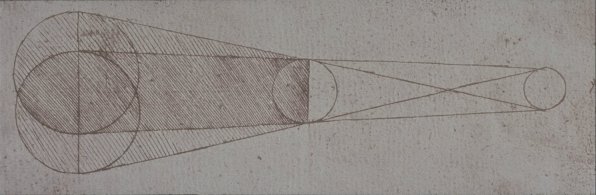
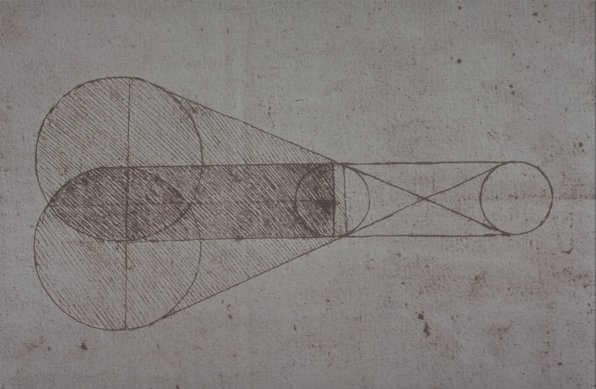
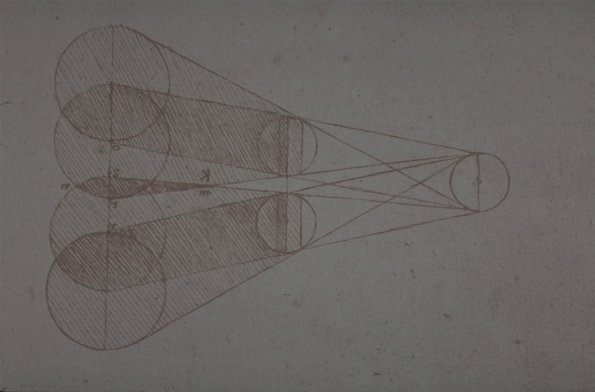
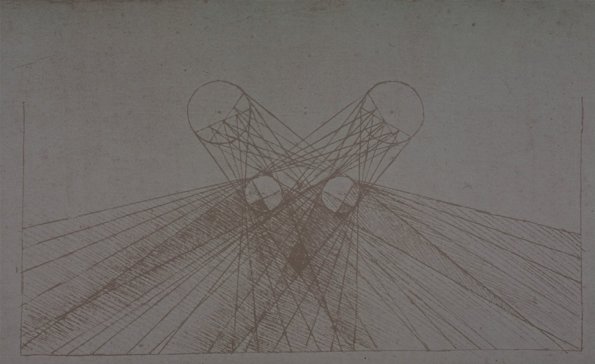
In isolation this list would have limited interest. But it becomes highly significant when we discover that Leonardo's notebooks contain many diagrams without text that exemplify precisely this approach. This method of playing with variables guides Leonardo in conceiving his Seven Books on Light and Shade and indeed all his optical studies[275]. However sceptics may rightly object that the existence of diagrams which can be arranged by others in a systematic fashion does not prove that Leonardo was systematic, or that he even intended such order. We need his word for it and fortunately it exists in the form of lists in various domains of his work. These confirm that Leonardo consciously plays with variables. On CA147va (c. 1500), for instance, he applies this principle to counterweights under the heading:
The regular natures of counterweights which press against the reservoir are 9, i.e.
Wider than the reservoir and heavier
Wider than the reservoir and lighter
Wider than the reservoir and equal
Narrower than the reservoir and heavier
Narrower than the reservoir and lighter
Narrower than the reservoir and equal
Equal to the reservoir and heavier
Equal to the reservoir and lighter
Equal to the reservoir and equal[276]
Here the essential elements of his method can be seen clearly. Leonardo takes one variable, in this case size, keeps it constant, while considering three kinds of weight (heavier, lighter, equal), then chooses another size and again holds it constant as he changes the weight variable. It is typical of Leonardo that he applies this systematic play of variables equally to declensions of verbs (pl. 9)[277]. Perhaps inspired by the work of grammarians he uses the same method to illustrate combinations of vowel sounds as on W19115r (K/P 114v, 1506-1508). Here he begins with the vowel "a", adds this to each consonant ofthe alphabet then does the same with "e" and the other vowels (pl. 10):
a e i o u ba be bi bo bu ca ce ci co cu da de di do du e fa fe fi fo fu ga ge gi go gu la le li lo lu ma me mi mo mu na ne ni no nu pa pe pi po pu qa qe qi qo qu ra re ri ro ru sa se si so su ta te ti to tu
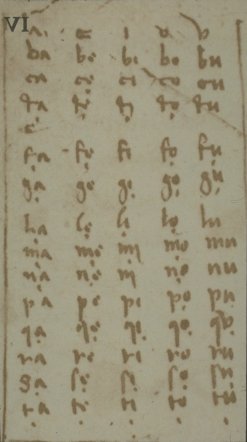
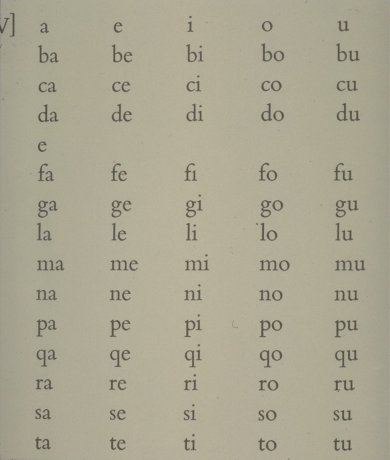
Such a list could readily be seen as an amusing game. But it is not in isolation and the way in which such list making is systematic becomes more apparent when we examine how Leonardo applies this method to geometry. There was a well established Renaissance interest in transformations of geometrical shapes known as the geometrical game (de ludo geometrico). Alberti had written a book on this[278], which Leonardo studied, as we know from a note on Arundel 66r.[279] On CA99vb Leonardo defined the geometrical game as giving "a process of infinite variety of quadratures of surfaces of curved sides."[280] But it soon became much more than a game. Leonardo saw it as a key to all systematic transformations of forms. On Arundel 154r (c. 1505), for instance, he explores basic transformations involving a pyramid.
a pyramid [is] extended to a given length
a pyramid [is] shortened to a given lowness
from a pyramid one makes a cube
from a cube one makes a pyramid
from a cube one makes a pyramid of a given height
from a pyramid of a given height one makes a cube
from a pyramid one makes a table of a given thickness
from a pyramid one makes a table of a given width
from a pyramid one makes a table of a given width and thickness[281]
Leonardo also makes lists of different kinds of transformations possible in geometrical objects. On CA245vb (1505-1506), for instance, he mentions: to shorten, lengthen, make fat, make thin, widen, restrict.[282] These he crosses out and then makes a list of twelve kinds of simple transmutation.[283] Eleven kinds of composite transmutation follow.[284] Again he crosses these out[285] and on Forster I 12r-11v (c. 1505) he uses these ideas as the basis for an extraordinary list of twenty eight kinds of transformation, the first twelve of which correspond to the simple kind, whose one aspect does not change and the remaining sixteen of which are composite, i.e., where all the aspects change (pl. 11):
1 shorten as much as one widens without changing the size 2 shorten as much as one thickens without changing the width 3 lengthen as much as one squeezes without changing the size 4 lengthen as much as one makes thin without changing the width 5 fatten as much as one squeezes without changing the length 6 fatten as much as one shortens without changing the width 7 thin as much as one widens without changing the length 8 thin as much as one lengthens without changing the width 9 widen as much as one thins without changing the length 10 widen as much as one shortens without changing the size 11 squeeze as much as one thickens without changing the length 12 squeeze as much as one lengths without changing the size 13 shorten and fatten as much as one widens 14 shorten and thin as much as one widens 15 shorten and widen as much as one size 16 shorten and squeeze as much as one fattens 17 lengthen and fatten as much as one squeezes 18 lengthen and thin as much as one widens 19 lengthen and widen as much as one thins 20 lengthen and restrict as much as one fattens 21 fatten and widen as much as one shortens 22 fatten and restrict as much as one lengthens 23 thin and widen as much as one lengthens 24 thin and restrict as much as one lengthens 25 fatten and lengthen as much as one restricts 26 fatten and shorten as much as one widens 27 thin and lengthen as much as one squeezes 28 thin and shorten as much as one widens[286]
This list comes at the end of a treatise with three books of numbered propositions cited earlier. We know, moreover, that Leonardo continued to work on these problems[287] In the last years of his life, on CA136ra (1517-1518) for instance, he makes another systematic chart relating to geometrical transformation (pl. 12):
Equal sagittas and chords have equal arcs
Equal sagittas and arcs have equal chords
Equal chords and sagittas have equal arcs
Equal chords and arcs have equal sagittas
Equal arcs and sagittas have equal chords
Equal arcs and chords have equal sagittas[288]
The regularity of these geometrical transformations led Leonardo to use them as a model for his concept of science (cf. above). Hence, both his transformational geometry and science became based on principles that were universal, reversible and repeatable.
The universality of this enterprise became apparent as he applied it to his study of nature. As we have shown Leonardo developed a mechanical model of nature. His study of machines convinced him that nature involved a surprisingly small number (21) of physical parts[289], governed in turn by basic powers of nature[290]. By 1492, Leonardo had become convinced that there were four such underlying powers of nature: force, motion, gravity and percussion. He described a series of preliminary experiments involving these powers in Manuscript A.[291] It is not until Mad I 152v (1499-1500), however, that we find evidence of systematic study which he prefaces with a brief, explicit statement that he is here making a thought experiment in trying to ascertain the laws of nature:
I have 4 degrees of force and 4 of weight and, similarly, 4 degrees of motion and 4 of time. And I wish to make use of these degrees and as necessary, I shall add or subtract in my imagination to find out what is required by the laws of nature.[292]
Leonardo then takes three of his powers of nature, plus the factor of time, and presents them as a systematic play of variables (pl. 18):
2 of weight and 4 of force and 4 of motion require 2 of time
2 of weight and 2 of force and 4 of motion require 4 of time
2 of weight and 2 of force and 2 of motion require 2 of time 2 of force and 4 of weight and 4 of motion require 8 of time
2 of force and 2 of weight and 4 of motion require 4 of time
2 of force and 2 of weight and 2 of motion require 2 of time 2 of motion and 4 of force and 4 of weight require 2 of time
2 of motion and 2 of force and 4 of weight require 4 of time
2 of motion and 2 of force and 2 of weight require 2 of time 2 of time and 4 of force and 4 of weight require 2 of motion
2 of time and 2 of force and 4 of weight require 1 of motion
2 of time and 2 of force and 2 of weight require 2 of motion1 of force and 4 of weight and 4 of motion require 16 of time
1 of time and 4 of motion and 4 of weight require 16 of force
1 of motion and 4 of weight and 4 of force require 1 of time
1 of weight and 4 of motion and 4 of force require 1 of time[293]
For our purposes the question whether these calculations are correct is of less interest than the conviction that a systematic approach will inevitably reveal the laws of nature. Leonardo never uses modern algebra in this process. It is significant, however, that he sometimes treats these basic variables as abstract symbols. OnCA212vbb(1502-1504), for example, he considers power (p), a variant name for force; space (s); motion (m); and time (t) and in addition to his verbal descriptions[294], produces a chart which summarizes these variables, underlining a different one each time (pl. 17):
p s m t p s m t p s m t p s m t p s m t
He makes another list for power, weight (g, i.e., gravita), motion and time.[295]He develops similar lists onCA355va(1502-1504) adding quantitative values to the symbols: e.g. s2 and t2.[296]We must take care not to read Galilean physics into this. Yet Leonardo's approach helps us to reconstruct the context which made Galileo's enterprise possible.
Leonardo pursues this theme by applying the same systematic play of variables to individual powers of nature. In the case of motion, for instance, he makes lists pertaining to different kinds thereof onCA165va(c. 1500-1503) (pl. 15):
On simple and composite
Straight , curved and straight
Curved, straight and curved
Curved and straight, straight
Straight and curved, curved
On composite
Curved and straight, straight and curved
Curved and curved, straight and straight
Straight and straight, curved and curved
Curved and curved, curved and curved
Straight and straight, straight and straight[297]
Similarly Leonardo makes a list of different kinds of mobile objects and surfaces onCA193rb(c. 1500), once again applying his method of systematic play with variables (pl. 16):
Hard mobile with a hard plane
Soft mobile with a soft plane
Hard mobile with a soft plane
Soft mobile with a hard plane
Rough mobile with a polished plane
Polished mobile with a rough plane
Rough mobile with a rough plane
Polished mobile with a rough plane[298]
Leonardo uses the same method with respect to percussion, another of his four powers of nature when, onCA74vb(1506-1508) he makes a list of possible kinds of percussion in water.
Encounters of water equal in power and in quantity
Encounters of water equal in power and not in quantity
Encounters of water equal in quantity and not in power
Encounters of water not equal in power and not in quantity[299]
This systematic approach to percussion is even more evident in his plan onCA65va(c. 1508) to study (pl. 14):
Percussion of rare in rare
Percussion of rare in dense
Percussion of dense in rare
Percussion of dense in dense[300]
TheWindsor Corpusprovides evidence that Leonardo is collecting these ideas in a systematic fashion, with the explicit purpose of writing a book. OnW19141v(K/P 99v, 1506-1508), for instance, he notes: "In this 4thbook I have to treat of six things as instruments, that is, the axle, round beam, lever, cord, weight and motor."[301]On the same folio he outlines the elements necessary to study: "the nature of the working parts required for the functioning of the capstan."[302]Directly beneath this is another of his charts with six variables (pl. 19a):
Given the axle, round beam, lever, cord and weight one seeks the motor
Given the round beam, lever, cord, weight and motor one seeks the axle
Given the lever, cord, weight, motor and axle one seeks the round beam
Given the cord, weight, motor, axle and round beam one seeks the lever
Given the weight, motor, axle, round beam and level one seeks the cord
Given the motor, axle, round beam, lever and cord one seeks the weight[303]
On the same folio Leonarto considers another combination, this time of five variables (pl. 19b):
Given the lever and counterlever, fulcrum and weight one seeks the motor
Given the counterlever, fulcrum, weight and motor one seeks the lever
Given the fulcrum, weight, motor and lever one seeks the counterlever
Given the weight, motor, lever and counterlever one seeks the fulcrum
Given the motor, lever, counterlever and fulcrum one seeks the weight[304]
He pursues these problems onW19143r(K/P 101r, 1506-1508) where he outlines the elements involved in a screw (pl. 20a):
Given the screw, screwthread, number, lever and weight one seeks the motor
Given the screwthread, number, lever, weight and motor one seeks the screw
Given the number, lever, weight, motor and screw one seeks the screwthread
Given the lever, weight, motor, screw and screwthread one seeks the number
Given the weight, motor, screw, screwthread and number one seeks the lever
Given the motor, screw, screwthread, number and lever one seeks the weight[305]
And on the same folio he makes a corresponding list pertaining to the parts of pulleys (pl. 20b):
Given the diameter, number, axis, weight and cord one seeks the motor
Given the number, axis, weight, cord and motor one seeks the diameter
Given the axis, weight, cord, motor and diameter one seeks the number
Given the weight, cord, motor, diameter and number one seeks the axis
Given the cord, motor, diameter, number and axis one seeks the weight
Given the motor, diameter, number, axis and weight one seeks the cord[306]
This is followed by a note which leaves little doubt that Leonardo is proceeding with a systematic plan in mind:
The parts of the pulleys given above are the diameter of the wheels of these pulleys, and the number of the wheels and the thickness of the axle which is within every wheel and the quantity of weight which is sustained by the pulleys and the thickness of the cord which pulls the weight, and the motor of this weight, which said things are six. Now five of them are given and the sixth is sought. This is indeed subtle investigation and will never be made without its theory, that is, the definition of the four powers, as weight, force, motion and percussion.[307]
This passage reveals why Leonardo is at such pains to study systematically the characteristics of weight, force, motion and percussion. These four powers of nature have become the basis of his theory of nature. Theory, moreover is here used in a special sense. Leonardo is claiming that one needs theory to provide a structure for, and to organize, the practical experience and experiments at one's disposal. Theory and practice are now interdependent. By contrast, in Antiquity and throughout most of the Middle Ages there had been an tendency to oppose theory and practice. This grew out of an assumption, supported by neo-Platonism, that theory was noble and practice was base. Hence, Plato'sTimaeuswas, for instance, replete with abstract thoughts and claims in isolation, with minimal reference to practical experience and no records of practical experiments. Lucretius' theory of the universe was presented in poetic form, and even the treatise of a practicing architect Vitruvius gave instructions in abstract terms without mention of practical variants. Vitruvius was concerned with how an Ionic column should look and did not discuss whether this was confirmed by examples of Ionic columns in Rome or Athens. For Vitruvius and his classical colleagues it was a question of theory versus practice. Leonardo's work convinces him of the need for a fundamentally different approach in which practical experience, experiment and testing using the controlled conditions of machines (pl. 25-28) will provide a basis for his theory.
Leonardo's paragraph is headed with a brief note: "The exercise and nature of the parts of pulleys and their relationships - 4thbook."[308]Mention of the 4thbook (in the sense of a chapter), confirms that this is intended to be part of the work cited above. A further note onW19060r(K/P 153r, c. 1509-1510) describes the contents of the book of which this was to have been a part.
On machines
Since nature cannot give motion to animals without mechanical instruments as I demonstrate in this book on the motive works of nature made in animals. I have, for this reason, composed the rules in the 4 powers of nature without which nothing can give local motion to these animals.[309]
Elsewhere onW19070v(K/P 113r, c. 1508-1510) Leonardo tells us that "the book of the science of machines precedes the book of the movements."[310]Is this book on the science of machines the same book as that to which Pacioli referred as being near completion in 1509 in the passage cited earlier? Of this we cannot be certain. There can be no doubt, however, that Leonardo was working methodically, that his lists of variables provided him with a means of studying controlled situations systematically. When applied to his transformational geometry this led to the treatise inForster Iwhich became a basis for later writings. When applied to his concept of the four powers of nature (weight, force, motion and percussion), this same method of listing variables which were to be experimentally tested, inspired further books. The next step, as was suggested above, was to combine these two sets of findings into a new synthetic vision. Hence the systematic play of variables which grew out of perspectival studies not only furnished Leonardo with a method. It persuaded him that he had something to say; was the reason for his notebooks and why he hoped to present his ideas in published form.
Seen in the context of centuries, Leonardo's work could be seen (indirectly) as a first draft for Descartes'Discourse on Method. It could also be seen as more. Leonardo's programme called for a systematic experimental catalogue of mechanical powers which for him constituted nature's principles. It took half a century before there were enough instruments around for this programme to become universal and another fifty years before the instruments were sufficiently accurate for this universality to attain the level of precision which made possible the syntheses of Kepler, Galileo and Descartes. The goal of explaining nature's principles could then be joined with a long standing goal of a systematic encyclopaedia of nature's contents, that is usually remembered as Baconian science.