Leonardo's Method · Chapter 5 of 15
3. Treatises
Both the size and contents of the notebooks vary considerably. There are tiny pocket-size booklets such as Forster III (9 x 6.7 cm) or Manuscript H (10.3 x 7.2 cm)[40] and large folio sheets such as the Codex Atlanticus and Windsor. In terms of contents the notebooks fall into three different kinds: travel notes, study notes and draft treatises.
When he travels Leonardo likes to make notes and he recommends this practice to his students[41]. Manuscript L is a good example. Here Leonardo does some surveying, sketches the lay of the town at Cesenatico, notes architectural features at Urbino etc.[42] A second category of study notes is based on both experiments and books, and involves gathering material for his basic themes. Some of this material was unbound. It is likely that Leonardo kept two large piles of unbound notes in his study: one devoted primarily to the man made world (machines, inventions and architecture), now the Codex Atlanticus; the other dealing mainly with nature (anatomy, botany and geology) now in Windsor. This division was not strict. After Leonardo's death, Pompeo Leoni attempted to sharpen the distinction between these two piles by cutting out various portraits and caricatures from the Codex Atlanticus and adding these fragments to the Windsor collection, as Carlo Pedretti has so elegantly shown.[43] There is evidence that Leonardo planned to have what is now the Windsor Corpus [44] bound, but this did not happen during his lifetime. Around 1508 the materials for what is now the Codex Arundel were also in an unbound state, although a note on Arundel 190v [45] mentions that he plans to have this bound also.
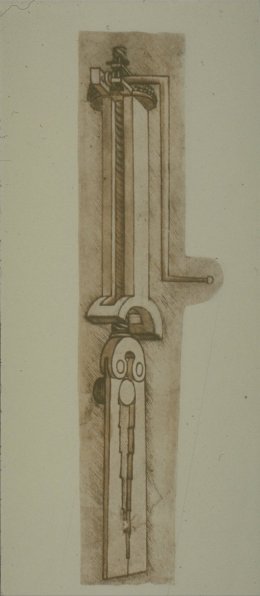
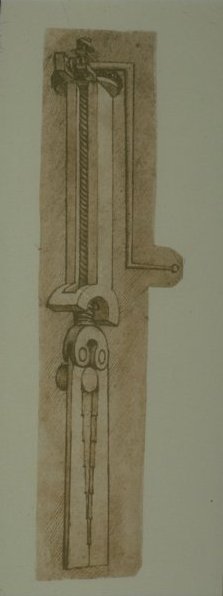
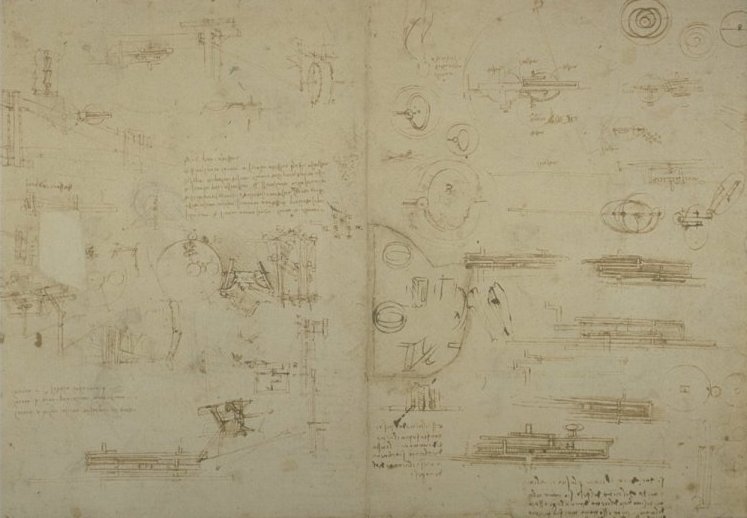
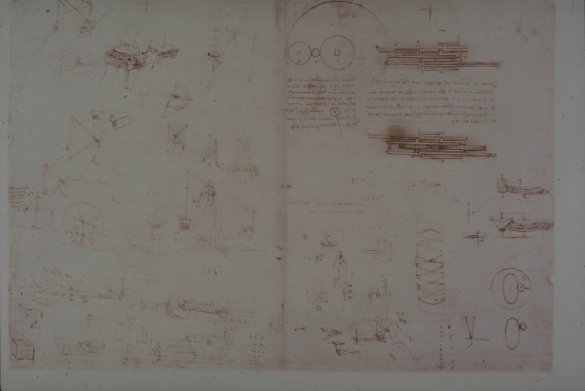
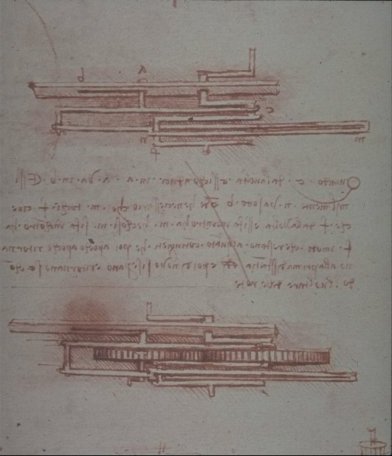
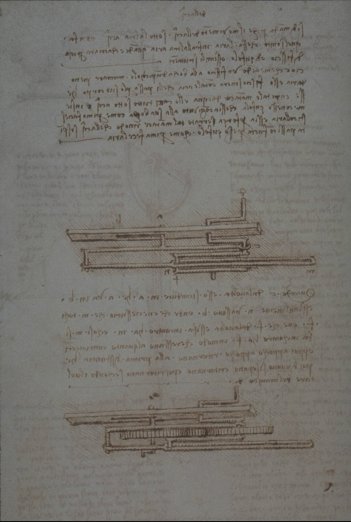
The number of topics dealt with on these loose sheets varies. A few contain many themes. A number of sheets contain two or three topics. The majority of sheets are dominated by or deal exclusively with one topic. There is, however, a spectrum of ways in which a theme is treated. In early stages of formulation, diagrams and texts are scattered indiscriminately (e.g.pl.1ab). In a further stage, there is some order. Then there are sheets with some evidence of numbering. Next a pattern of texts with illustrations or vice-versa emerges. Finally we find sheets showing a single example sometimes with an accompanying text. Some of these are presentation drawings intended to be shown separately (cf. pl. 2ab), while others become parts of treatises. In the notebooks which are bound, most folios deal with a single theme and this usually continues over a number of pages. Indeed the majority of the manuscripts are dominated by only a few themes. As Leonardo's ideas evolve he copies them or has them copied into another manuscript, crossing out the original passage involved (pl. 3-4). A note at the beginning of the Codex Arundel suggests that it was drawn up in this way. In the case of the Treatise of Painting, Melzi added a sign alongside passages that he copied from manuscripts such as BN 2038, A, E and G.
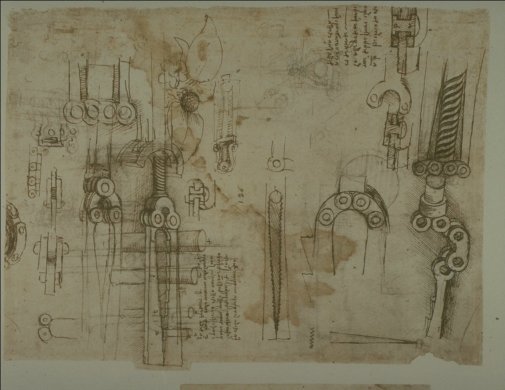
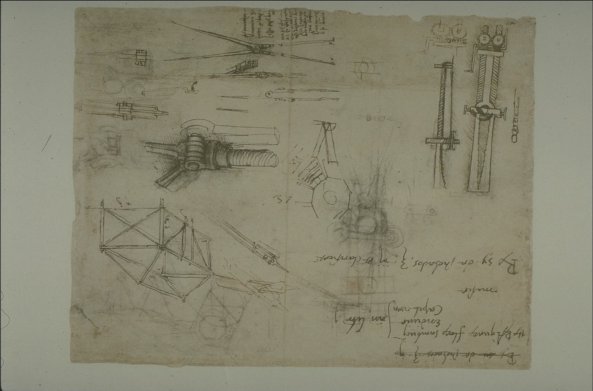
Leonardo's earliest bound notebooks, the Codex Trivulzianus (1487-1490, 21 x 14 cm), Manuscript B (c. 1488-1490, 31 x 22 cm) and Manuscript A (c. 1492, 21 x 14 cm) are large in size,and generous in their use of paper. But paper must have become increasingly scarce. On rare occasions, such as CA206ra (549r, c. 1497), Leonardo proceeds in palimpsest fashion, writing over a passage with a new topic. Elsewhere, especially in the Windsor Corpus and the Codex Atlanticus, we find instances where he seems determined to use every inch of space. This is partly because he keeps returning to a sheet in order to add further notes on a given topic, which explains why the dates of these two manuscripts range from the beginning to the end of his career.
Some of the bound manuscripts can be described as study notes insomuch that the order of the folios remains implicit. Manuscript A, which contains his treatise on perspective is an example. The treatise begins on A36v. There is a number 4 at the bottom of the folio, which is repeated at the top of A37r. Similarly at the bottom of A37r there is a 5 which is repeated at the top of A37r. These are the only formal clues of sequence. But as I have shown elsewhere[46] the argument proceeds methodically from 36v through to 42v, thus comprising a short, thirteen-page treatise. A second such treatise is found in Forster II. It goes backwards beginning at 158v and ending at 65v. There is an independent numbering to help us. Hence, folio 158v is 1, 157v is 2...68v is 91, 67v is 92, 66v is 93 and 65v is 94. This accounts for the cryptic note in Latin: "Most powerful mechanics, beginning at the end."[47] Another instance is found in Manuscript M, where a discussion on motion and percussion continues in sequence from 94r to 93v and so on to 90r, thus making a brief treatise of nine pages.
There are also notebooks in which order remains mainly implicit except for isolated passages which give hints of a larger plan. An example is Manuscript F which contains a draft of a chapter for his treatise on cosmology. A note on F94v outlines the overall purpose of the book:
My book sets out to show how the ocean along with the other seas, with the help of the sun, makes our planet reflect light the way the moon does and from a greater distance appears like a star, and this I prove.[48]
By way of introduction Leonardo feels he must establish that the eye is not being deluded when it looks at the sky. So he writes a chapter on optics. This begins on F95v. At the bottom of the paragraph he writes: "It is not possible to define this here for lack of paper, but go to the beginning of the book [i.e., chapter] at folio 40 where this is defined."[49] At folio 40 the treatise continues and proceeds backwards to 39v,39r and so on through to 28r. I have made a complete analysis of this treatise elsewhere.[50] It is important for our purposes here to note that Leonardo also uses this method with respect to other themes discussed in the same manuscript. On F13v, for instance, he writes "Turn the page."[51] On F26v he writes "Here follows the proof of that which is said on the page opposite."[52] On F52r he notes "Go to page 59."[53] All this is not simply because he is being obtuse. These were times of war. Paper was in great shortage. There were many interruptions. These were his working notes. But even so, he too wanted order.
Similar notes are found in two other manuscripts. In the case of Manuscript E, the page sequence again is frequently the opposite of his argument, i.e. he starts at the back and works forward. Hence, when on E75r he writes "Here is finished what is lacking three pages before this,"[54] We need to go to 77r to find the relevant passage. Manuscript G contains at least seven notes of this kind. On G44v Leonardo writes "And this is drawn in the margin at the bottom four folios following[55]," i.e. G48r. On G46r he writes: "Here follows what is lacking on the page opposite"[56], i.e. 45v. On G46v he notes: "Read page 45[r]."[57] On G51v he writes "go to page 44."[58] On G67r he explains that the text continues on the page opposite at the bottom[59], i.e. 66v. On G75r he adds two notes: "Here follows what is on the opposite page[60]," i.e., 74v at the top, and also "the round beam is drawn on the page opposite."[61] Finally on G80r there is a similar note.[62] The sequence of his argument is much more erratic in G than elsewhere. He is working in Rome at the time (1513-1515), and developing his pyramidal law with respect to mirrors[63], precisely the kind of information that the German industrial spy, Johannes, the mirror maker, was trying to steal. I suspect that Leonardo was in this case consciously giving a superficial impression of chaos.
In a third kind of manuscript Leonardo uses part or even a whole manuscript to gather material related to a specific topic. This kind of treatise confirms that Leonardo is capable of more coherent and systematic presentation. An early example is Manuscript C (c.1490-1491), which deals with light and shade. The most interesting example is Forster I (c. 1505). A note in mirror script on Forster I 3r informs us that this is a "book entitled on transformation of one body into another without diminution or augmentation in material."[64] This note has been rewritten in ordinary script by a later reader. A note on 3v, which has again been rewritten in ordinary script informs us that this manuscript was "begun by me, Leonardo da Vinci on the 12th of July 1505."[65] The actual treatise begins on 39v with a proposition numbered "1st." On 39r a 2nd and 3rd proposition follow. These continue in order until proposition II on 35r. From 34v through 28v (pl. 7-8) there is a second series of 13 numbered propositions. From 28r through 20r there is a third series of 20 numbered propositions. His numbered list of 28 geometrical transformations cited earlier gives us another glimpse of the order he had in mind. The latter part of Forster I, namely folios 40v through 55r, deals with a distinctly different topic, hydraulic machines. Here the diagrams are much rougher and the general impression is more chaotic. If we look closely, however, we find that beginning on folio 45r the diagrams are numbered 1, 2 and respectively. On 45v we find the numbers 4, 5 and 6. This continues in orderly fashion until numbers 41 and 42 on 53r.
This principle of numbering the illustrations by way of establishing the sequence of his ideas recurs in Madrid Codex I, this time in the context of weights and balances (pl. 5-6). On Mad I 190r Leonardo adds to his illustrations the numbers 3, 4, 5 and 6. This sequence of numbers continues in the opposite direction of pages such that we find illustration 100 on folio 172r. This sequence then begins a fresh on this same folio 172r with figures 1 and 2 and continues until figure 90 on folio 158r. In Manuscript K, beginning on 79r, this time in the context of geometrical diagrams we find two numbered propositions which continue in sequence until 14 on folio 73r. A late example of this approach is Manuscript D (c.1508), on problems of vision.
As will become evident, by 1492 Leonardo had developed an explicit method for presenting his ideas that was reminiscent of the form Euclid established for classical geometry: a proposition (i.e. a claim), followed by demonstrations (i.e. examples based on experiment or at least experience), frequently accompanied by illustrations to show different possibilities. In the notebooks, the propositions increasingly serve as headings for demonstrations in paragraph form accompanied by diagrams, often in the margin. This procedure is seen clearly in Codex Leicester (now Hammer) and Manuscripts E, F and G. Sometimes the margins give summary versions of the proposition, as in Manuscript D. Hence, in addition to his travel and study which are frequently without a planned order, Leonardo has a clear method of presentation when he begins to organize these with a view to creating formal treatises[66].
Besides this physical evidence there are clear references in Leonardo's notebooks to specific books and propositions. Some of these are in the Codex Atlanticus. On CA384ra (1493-1495), for instance, Leonardo mentions: "I stated in the 7th conclusion how percussion...."[67] On CA155vb (1495-1497) he asks us to "look at the 7th [proposition] of the fifth [book] of the axle and the wheel."[68] On CA2ra (1515) we find a precise reference to his book on machines discussed earlier:
Since without experience one cannot give true science of the power by means of which the drawn wire resists that which draws it, I have drawn here, on the side, these four motor wheels of the perpetual screws, marking the degrees of power alongside each one. These powers are true as is proved in the 13th [proposition] of the 22nd [chapter] of the elements of machines written by me.[69]
Another late note on CA287re (c. 1514-1515) informs us that "Mr. Battista dall'Aquila, private secretary to the pope, has my book in his hands."[70] In the Codex Arundel, on folio 12r, Leonardo refers us to "the 5th of the 7th"[71] in connection with weights. On Arundel 25r, he mentions "as proved in the 4th of my [book on] perspective."[72] On Arundel 25v he refers to "book 9 of water".[73] Sometimes the references are laconic as on K30r to a "sixth book"[74] or in Manuscript F where there are at least four references to "book 9 on water" on folios 5r, 24v, 72v and 88r respectively, two references to a "book 10 on water" on folios 4v and 24v, plus headings on 35r for "Book 42. On rain"[75] and on 37r for "Book 43. On the motion of air included below water"[76], as well as a simple note on 66v: "Beginning of book [of water]."[77] On Manuscript I 72v there is also a: "Beginning of book on water."[78] On E59v (1513-1514) there is a: "Beginning of this book on weights"[79] and on E27v there is a note: "proved by the ninth of percussion."[80] On W19061r (K/P 157r) we read: "proved by the 5th on force."[81] Leonardo also refers on W19061r (K/P 154r) to the "order of the book [of anatomy]....Hence with these 15 entire figures the cosmography of the microcosm will be shown to you with the same order as Ptolemy used before me in his Cosmography".[82] Thus Ptolemy's method of arranging the macrocosm serves as a direct model for how Leonardo arranges the microcosm. On W19009r (K/P 143r) Leonardo refers once more to his book on machines:
Make sure that the book on the Elements of Machines with its practice comes before the demonstration of motion and force of man and other animals, and by means of these you can prove all your propositions.[83]